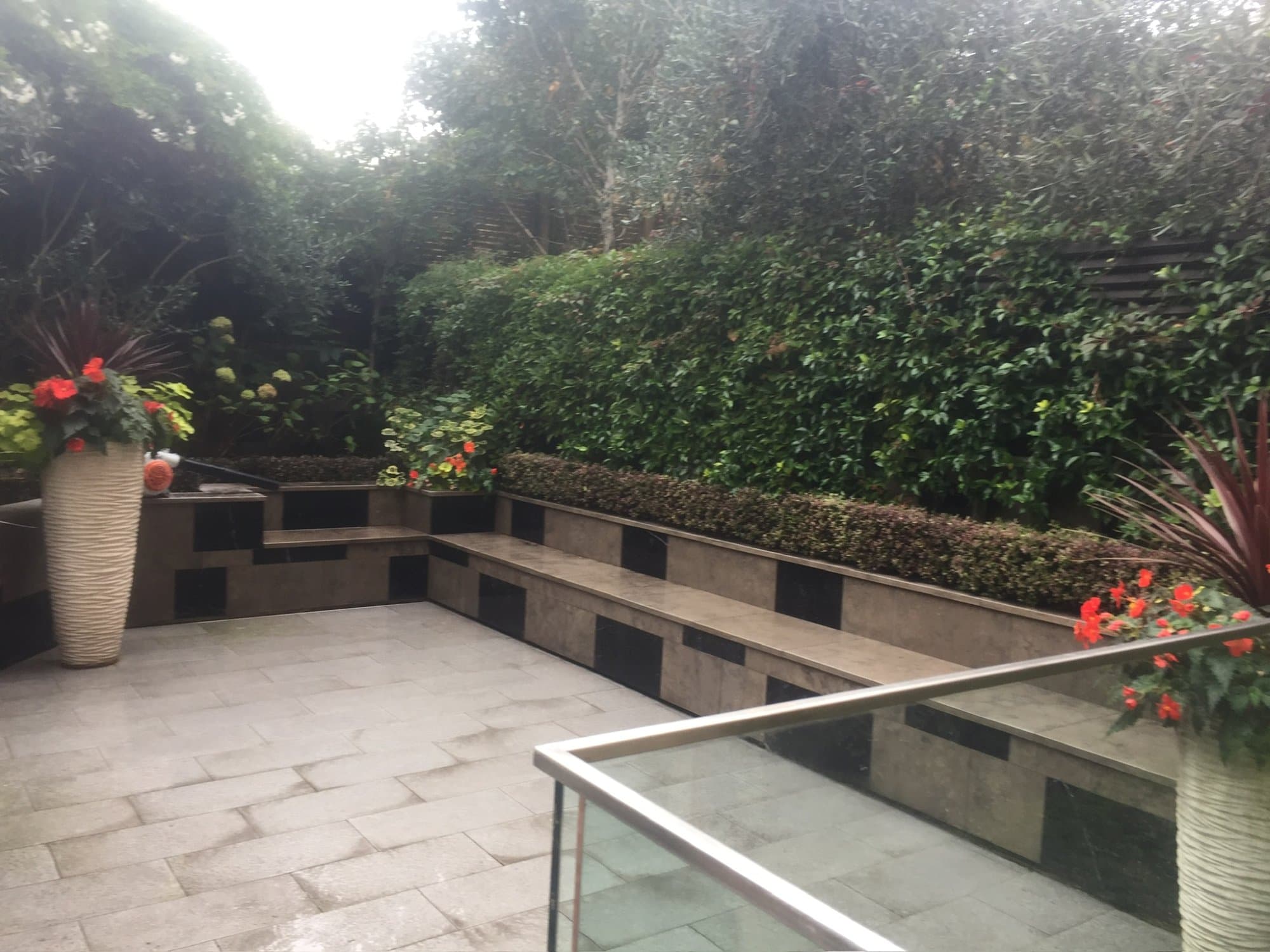
A courtyard is not a compromise. With the right proportions, planting and light, the smallest North London gardens can be the ones you use most.
Most of the gardens we are asked to look at in North London are small. Victorian side returns, Georgian courtyards, the six-by-four rectangle behind a terrace. Owners tend to apologise for them (“it’s only tiny”) as though size were the problem. It rarely is. The problem is almost always that the space has never been asked to do anything on purpose.
A small garden is a discipline, not a disappointment. Every decision shows, so every decision has to be right. Get the proportions, the greenery and the light in order and a courtyard will out-perform a garden five times its size, because you will actually use it.
Treat it as a room, not a garden
The single most useful shift is to stop thinking of a small space as a shrunken lawn-and-borders garden and start thinking of it as an outdoor room. Rooms have a floor, walls and a purpose. Decide what the space is for (somewhere to eat, somewhere to sit with coffee, somewhere green to look at from the kitchen), and design backwards from that one job.
Once you know the purpose, the layout usually resolves itself. A dining courtyard wants its floor kept clear and its seating built in. A green retreat wants planting on every surface and a single good place to sit. Trying to make one small space do everything is how you end up with something that does nothing.
Grow up, not out
Floor space in a small garden is precious, so the greenery has to go somewhere else. Walls are the answer. Climbers on wires, trained trees, wall-mounted planting and the occasional restrained green wall let you drown a courtyard in foliage without losing a centimetre of floor.
- Star jasmine (Trachelospermum jasminoides): evergreen, scented, and forgiving in shade
- Climbing hydrangea for a shady, north-facing wall
- A single multi-stem tree (amelanchier or birch) for height and dappled light
- Ferns and Fatsia japonica to hold the ground layer in low light
Chase the light
North London courtyards are often overshadowed, and the instinct is to fight the shade. Don’t. Work with it. Pale paving and pale walls bounce what light there is around the space. A mirror, used once and with restraint, can open a corner. And because these gardens are so often used in the evening, the lighting matters as much as the daylight. A few warm, low-level fittings will do more for a courtyard than any amount of sunshine it was never going to get.
A small garden done well is not a smaller version of a big one. It is a different, sharper kind of design, and often the more rewarding.
Fewer things, better made
The last principle is restraint. A small space cannot absorb clutter. One good material for the floor, one built-in bench, one water feature, one tree (chosen well and detailed properly) will always beat a scatter of pots, furniture and features competing for the same few square metres. In a small garden, what you leave out is as important as what you put in.
If you have a courtyard, side return or roof terrace you have written off, it is almost certainly capable of far more than it is giving you. We would be glad to take a look.